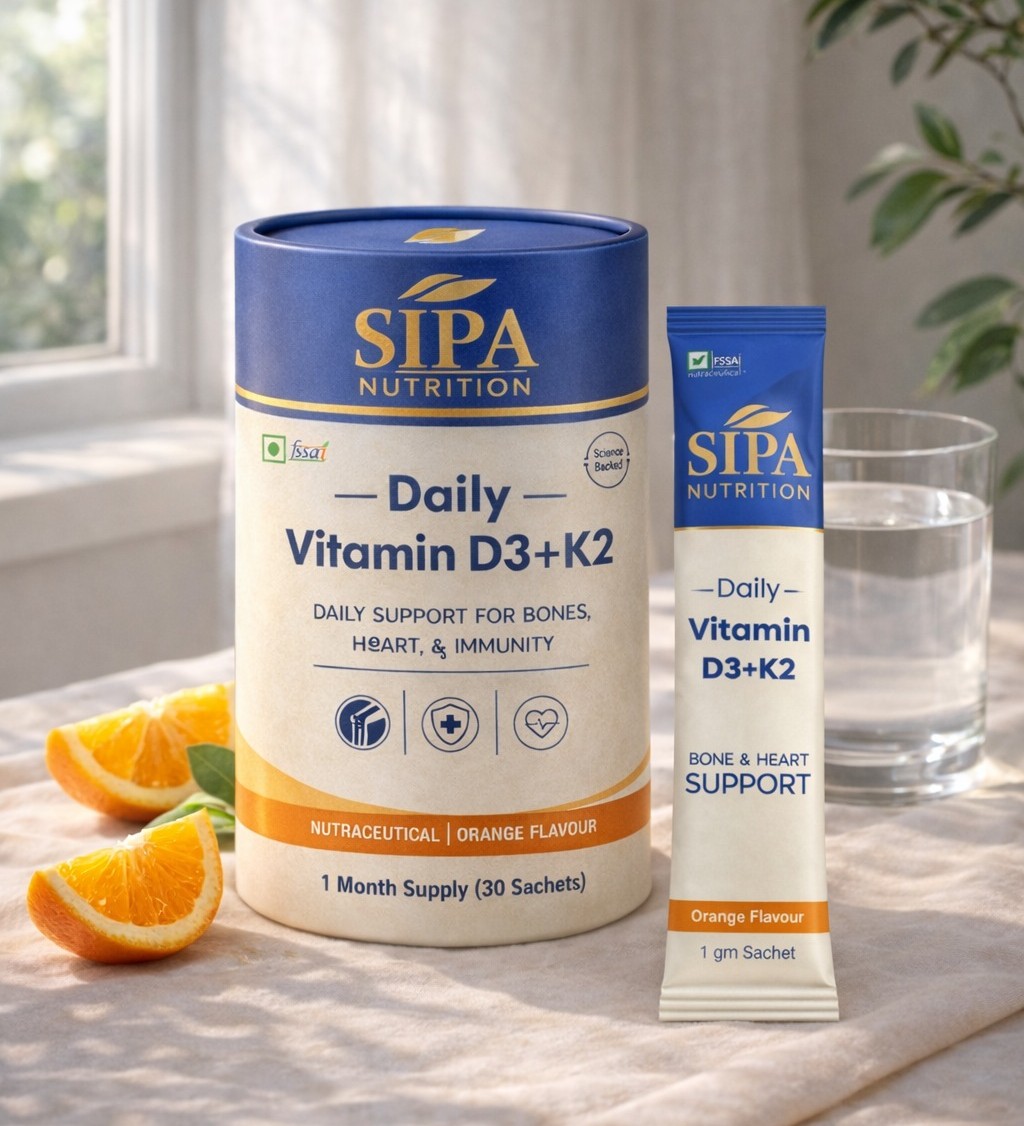
If you're taking a standard Vitamin D3 supplement, you might only be solving half the problem. While modern blood tests consistently urge us to boost our Vitamin D levels, they leave out a crucial missing piece.
Vitamin D3 is mathematically incomplete without Vitamin K2.
These two nutrients share an undeniable biochemical link. D3 absorbs calcium into your bloodstream, but it has absolutely no control over where that calcium goes next. Without K2 acting as a precise guide, excess calcium can deposit in your arteries and soft tissues instead of your skeleton.
What Is Vitamin K2 —
the Nutrient Most Supplements Ignore?

Vitamin K2 is arguably nutrition science's most underappreciated compound. Many people confuse it with Vitamin K1 (which handles blood clotting via leafy greens). However, K2 serves an entirely different, critical function.
Cause: You ingest K2.
Effect: It activates dormant structural proteins.
Outcome: Calcium is safely routed away from your heart and permanently locked into your bones.
Specifically, K2 turns on two essential proteins. Found in the bone matrix, osteocalcin actively binds circulating calcium into your skeleton to improve density. Meanwhile, Matrix Gla-Protein (MGP) acts as a biochemical sweeper, actively preventing free calcium from calcifying over soft tissues.
When selecting a supplement, the MK-7 (menaquinone-7) form of K2 is vastly superior. Unlike the older MK-4 form which degrades in mere hours, MK-7 continuously activates proteins for over 24 hours from just a single dose.
"Vitamin K2 is the body's calcium traffic controller. It dictates exactly where the calcium (that D3 absorbed) should go — and more importantly, where it should never go."
The Calcium Routing Problem — Why K2 Is Essential
Activates Osteocalcin
K2 is the trigger that enables osteocalcin to bind absorbed calcium into bone tissue — the crucial final step most people miss.
Activates Matrix Gla-Protein
K2 activates MGP to prevent calcium from hardening in artery walls — a key factor in long-term cardiovascular and kidney health.
Mitochondrial Support
Emerging research shows K2 supports mitochondrial membrane function, contributing to energy production at the cellular level.
Tooth Mineralisation
The same osteocalcin that mineralises bone also strengthens tooth enamel — making K2 important for long-term dental resilience.
What Is Vitamin D3 —
and Why Are We Globally Deficient?
Vitamin D3 (cholecalciferol) is the precise form of Vitamin D your body synthesises from natural UVB sunlight. Despite its name, it isn't actually a vitamin — it's a powerful steroid hormone.

Indoor office lifestyles, severe air pollution blocking UVB rays, naturally darker skin tones, and daily sunscreen use have created a perfect storm. Today, D3 deficiency remains one of the world's most widespread hidden health crises.
How Your Body Makes Vitamin D3
What Vitamin D3 Does in the Body
Calcium Absorption
D3 stimulates intestinal uptake of calcium and phosphorus. Without it, your bones cannot access dietary calcium — no matter how much dairy you consume.
Immune Regulation
D3 modulates both innate and adaptive immune responses, helping the body distinguish between genuine threats and healthy tissue.
Muscle Function & Fatigue
Low D3 is directly linked to muscle weakness, chronic fatigue, and a higher risk of falls — especially in adults over 40.
Mood & Cognitive Function
D3 receptors are found throughout the brain. Deficiency has been associated with low mood, seasonal depression, and accelerated cognitive decline.
Heart & Blood Pressure
D3 plays a role in regulating blood pressure and reducing systemic inflammation — both central to long-term cardiovascular health.
The Calcium Paradox: Why D3
Requires a Co-Pilot

Here is the medical truth that standard supplement labels completely ignore: supplementing high daily doses of Vitamin D3 without K2 is biologically reckless.
When you take D3, your body dramatically upregulates its absorption of calcium. Without K2 to activate the "calcium-guiding" proteins, that free-floating mineral settles into blood vessel walls, joints, and kidneys — a biological error known as vascular calcification.
The D3 + K2 Calcium Pathway
The exact 3-step biochemical sequence that only functions when both vitamins are taken daily.
Vitamin D3 Absorbs Calcium
D3 triggers calcium uptake in the gut. Without D3, only ~10–15% of dietary calcium is absorbed.
Vitamin K2 Directs Calcium
K2 activates osteocalcin and Matrix Gla-Protein — guiding calcium into bones and away from arteries.
Calcium Reaches the Right Place
Bones mineralise. Arteries stay clear. The full cycle completes — only when both D3 and K2 are taken daily.
What the Research Says
A landmark study in the Journal of Bone and Mineral Research demonstrated that combined D3 and K2 supplementation was significantly more effective at improving bone mineral density than D3 alone. Separately, a three-year trial published in Thrombosis and Haemostasis found that MK-7 supplementation markedly reduced arterial stiffness in postmenopausal women.
SIPA Nutrition's daily sachet delivers both in the clinically recommended ratio — vegan and 100% lab tested.
Built for Your Body's Needs
While both nutrients benefit nearly everyone, certain groups have a particularly pressing need for consistent daily supplementation:
Office Workers
8–10 hrs indoors = near-zero UVB. Supplementation is essential.
Vegans & Vegetarians
K2 is almost absent in plant-based diets. Non-negotiable to supplement.
Adults Over 40
Skin D3 synthesis and bone density both decline steadily with age.
Athletes
Heavy training raises demand for bone mineralisation and muscle recovery.
Pregnant & Nursing
Critical for the baby's skeletal structure and immune development.
Post-Menopausal Women
Accelerated bone density loss after menopause makes D3 + K2 essential.
Nothing Hidden,
Nothing Extra
Not all D3 + K2 supplements are created equal. Five criteria separate a well-formulated product from marketing noise:
Vegan D3 (Lichen-Sourced)
Most D3 is derived from lanolin — a wax from sheep's wool — disqualifying it for vegetarians and vegans. Insist on lichen-sourced D3, biologically identical and 100% plant-based.
MK-7, Not MK-4
MK-4 has a half-life of just a few hours. MK-7 remains active for 24+ hours, making once-daily dosing clinically effective. Always verify the form on the label.
Third-Party Lab Testing
Supplements are not as tightly regulated as pharmaceuticals. 100% independent lab testing — verifying potency, purity, and safety — is the gold standard.
100% RDA — No More, No Less
The optimal daily maintenance dose is 600 IU D3 and 55 mcg K2 MK-7. Clinically safe for long-term use without a prescription.
Everyday Health,
Expertly Designed

SIPA Nutrition's Vitamin D3 + K2 sachets deliver a precise, clinically-effective stack. No sugars, no fillers, no compromises. Just a clean, active compound designed to protect your skeletal and cardiovascular systems in one simple daily step.
Cholecalciferol
600 IU100% RDAVia VitaShine® lichen — the purest plant-based D3 available, bioidentical to sun-derived D3.
Menaquinone MK-7
55 mcg100% RDALongest-acting K2 form available — sustains full protein activation for 24+ hours per dose.
Natural Orange
q.s.NaturalNo added sugar. No artificial additives. Just a clean, pleasant daily taste.
Carrier Agents
q.s.GRASGenerally Recognised As Safe by all major global regulatory bodies. Nothing hidden, nothing extra.
A Simple Daily Ritual
One Sachet Per Day
One slim 1g sachet daily — precisely dosed, no measuring, no guesswork.
After Morning Breakfast
Consistent morning use builds the habit and aligns with natural absorption patterns.
With a Fat-Containing Food
Both D3 and K2 are fat-soluble — pair with eggs, nuts, or whole milk to maximise absorption.
Daily Maintenance — Long Term
Formulated for sustained use. Results build over weeks; the real payoff is month-on-month consistency.
India's best Vegan Daily
D3 + K2 Sachet
Clinically dosed. 100% vegan via VitaShine®. Independently lab tested. No sugar, no fillers.
₹599
30 sachets · 30-day supply
Free shipping · FSSAI certified
People Also Ask
Vitamin D3 increases the amount of calcium your body absorbs from food. Without K2, that extra calcium can deposit in arteries and soft tissue instead of bones. K2 activates two proteins — osteocalcin and Matrix Gla-Protein — that direct calcium specifically into bones and prevent arterial calcification. Together, D3 and K2 complete the calcium pathway safely and effectively.
Yes. Vitamin D3 deficiency is strongly linked to chronic fatigue, muscle weakness, and low energy. D3 plays a direct role in mitochondrial function and muscle physiology. Restoring D3 to optimal levels through daily supplementation typically results in measurable improvements in energy and stamina within 4–8 weeks.
Yes — completely. Vegan Vitamin D3 (cholecalciferol) sourced from lichen, such as VitaShine®, is molecularly identical to D3 derived from lanolin (sheep's wool). The body absorbs and metabolises both forms in exactly the same way. For people following a plant-based diet, lichen-sourced D3 is the gold-standard alternative.
Common signs include persistent fatigue, frequent illness or infections, bone pain, muscle weakness, mood changes or low mood, and hair loss. In India, where around 76% of the population is estimated to be Vitamin D deficient, these symptoms are extremely common but often misattributed. A simple blood test (25(OH)D) can confirm deficiency.
Morning, with a fat-containing meal. Vitamin D3 is fat-soluble, meaning it absorbs significantly better when consumed alongside dietary fat — such as eggs, nuts, avocado, or whole milk. Morning intake also aligns with your natural circadian rhythm and makes it easier to build a consistent daily habit.
Blood Vitamin D levels typically begin improving within 1–2 weeks of consistent supplementation. Energy, immunity, and mood improvements are often noticeable after 4–6 weeks. Measurable bone strength improvements are typically observed around the 3-month mark with daily use.
Good Questions
Deserve Answers
Everything you need to know before you begin your daily D3 + K2 routine.
You can, but it is not advisable. Vitamin D3 increases calcium absorption significantly. Without K2 to activate the proteins that guide calcium into bones, that calcium can accumulate in arteries and soft tissues over time. For long-term bone and cardiovascular safety, always take D3 alongside K2.
Yes, completely. Vegan D3 sourced from lichen via VitaShine® is chemically identical to D3 from animal sources. Your body absorbs and uses both forms in precisely the same way. The only difference is the source.
Both vitamins are fat-soluble and absorb best when taken with a fat-containing meal. Morning after breakfast — with eggs, nuts, avocado, or whole dairy — is the optimal window for absorption and habit consistency.
Yes. At a daily maintenance dose of 600 IU D3 and 55 mcg K2 MK-7, long-term daily supplementation is clinically safe and widely recommended by doctors without requiring a prescription.
Vitamin D levels typically begin restoring within the first week. Immunity and muscle function improvements are often felt after about one month. Measurable bone strength improvements typically appear around the three-month mark.
Yes — 100%. SIPA Nutrition uses VitaShine® D3 sourced from lichen, a completely plant-based ingredient. There are no animal-derived ingredients of any kind in the formulation.
No. The formula contains no added sugar, no artificial flavours, and no artificial additives — only natural orange flavour and GRAS-certified excipients recognised as safe by all major global regulatory bodies.
The Bottom Line
Vitamin D3 and K2 are arguably the two most important daily nutrients for your long-term health trajectory. But as the science clearly shows, their true power only activates when they are taken together.
"Don't just supplement. Supplement biologically smart. D3 without K2 is a mathematical half-answer to a whole-body problem."
SIPA Nutrition was built on exactly this principle — to offer daily D3 + K2 sachet that's vegan, clean, clinically dosed, and independently lab-tested.
Try SIPA Nutrition's Vitamin D3 + K2 sachets — 30 sachets, one a day, ₹599. Vegan. 100% lab tested.
Disclaimer: This article is for informational and educational purposes only. It is not intended to diagnose, treat, cure, or prevent any disease. Always consult a qualified healthcare professional before starting any new supplement regimen.
Related Articles
7 Hidden Signs of Vitamin D Deficiency Most Indians Miss
From unexplained fatigue to frequent infections — how to recognise Vitamin D deficiency before it becomes a serious health issue.
When to Take Vitamin D3: Morning vs Night vs With Food
Timing matters for fat-soluble vitamins. A clear, science-backed guide to optimal D3 absorption windows and daily dosing.
Vegan Sources of Vitamin D3: Why Lichen Is the Gold Standard
Why most D3 supplements use sheep-derived lanolin, and why plant-based VitaShine® D3 is the better choice for everyone.
Looking for an easy daily Vitamin D3 + K2 supplement?
Try SIPA Nutrition Daily D3 + K2 Sachets — India's first vegan D3+K2 formula. 600 IU VitaShine® D3 + 55 mcg K2 MK-7. Clinically dosed. 100% lab tested. No sugar.
Shop Now — ₹599References & Citations
- Holick, M.F. (2007). Vitamin D Deficiency. New England Journal of Medicine, 357(3), 266–281. doi:10.1056/NEJMra070553
- Aparna, P. et al. (2018). Vitamin D deficiency in India. Journal of Family Medicine and Primary Care, 7(2), 324–330. doi:10.4103/jfmpc.jfmpc_78_18
- Schurgers, L.J. et al. (2007). Vitamin K–containing dietary supplements: comparison of synthetic vitamin K1 and natto-derived menaquinone-7. Blood, 109(8), 3279–3283. doi:10.1182/blood-2006-08-040709
- Knapen, M.H.J. et al. (2013). Three-year low-dose menaquinone-7 supplementation helps decrease bone loss in healthy postmenopausal women. Osteoporosis International, 24(9), 2499–2407. doi:10.1007/s00198-013-2325-6
- van Ballegooijen, A.J. et al. (2017). The synergistic interplay between vitamins D and K for bone and cardiovascular health. International Journal of Endocrinology, 2017, 7454376. doi:10.1155/2017/7454376
- Aranow, C. (2011). Vitamin D and the immune system. Journal of Investigative Medicine, 59(6), 881–886. doi:10.2310/JIM.0b013e31821b8755
- Sato, T. et al. (2012). Comparison of menaquinone-4 and menaquinone-7 bioavailability in healthy women. Nutrition Journal, 11, 93. doi:10.1186/1475-2891-11-93
- Cashman, K.D. (2020). Vitamin D deficiency: Defining, prevalence, causes, and strategies of addressing. Calcified Tissue International, 106(1), 14–29. doi:10.1007/s00223-019-00559-4